


If you’ve spent any time searching for managed WordPress hosting in 2026, you’ve almost certainly come across Rocket.net. It’s been showing up in comparison threads, WordPress Facebook groups, and hosting forums with unusual frequency—and not in a spammy way. People are genuinely talking about speed test results they can’t explain any other way.
Core Web Vitals have matured from a Google experiment into a genuine ranking signal. Slow sites don’t just frustrate visitors—they lose ground in search. That shift has pushed serious site owners away from shared or budget hosting toward premium WordPress hosting that can actually deliver performance under real-world conditions.
So where does Rocket.net fit in? And is the hype justified? I’ve spent time across multiple managed WordPress platforms—Kinsta, WP Engine, Flywheel, SiteGround, and Rocket.net—and here’s my honest take.
Is Rocket.net Worth It in 2026?
Yes, for most serious WordPress users. Rocket.net delivers genuinely fast load times backed by Cloudflare Enterprise infrastructure, strong security, and a clean management dashboard — all at a price point that’s competitive with Kinsta and WP Engine. If WordPress performance and uptime reliability matter to your business or store, Rocket.net earns its place in the top tier. It’s not the cheapest option, but you’re paying for infrastructure, not just a brand name.
Quick Verdict
| Category | Rating |
|---|---|
| Performance | ⭐⭐⭐⭐⭐ |
| Ease of Use | ⭐⭐⭐⭐ |
| Support | ⭐⭐⭐⭐ |
| Security | ⭐⭐⭐⭐⭐ |
| Value for Money | ⭐⭐⭐⭐ |
Recommended for: Business sites, WooCommerce stores, agencies, and high-traffic blogs where speed and uptime directly affect revenue. Less ideal for hobbyist sites or anyone watching every dollar.
What Is Rocket.net?
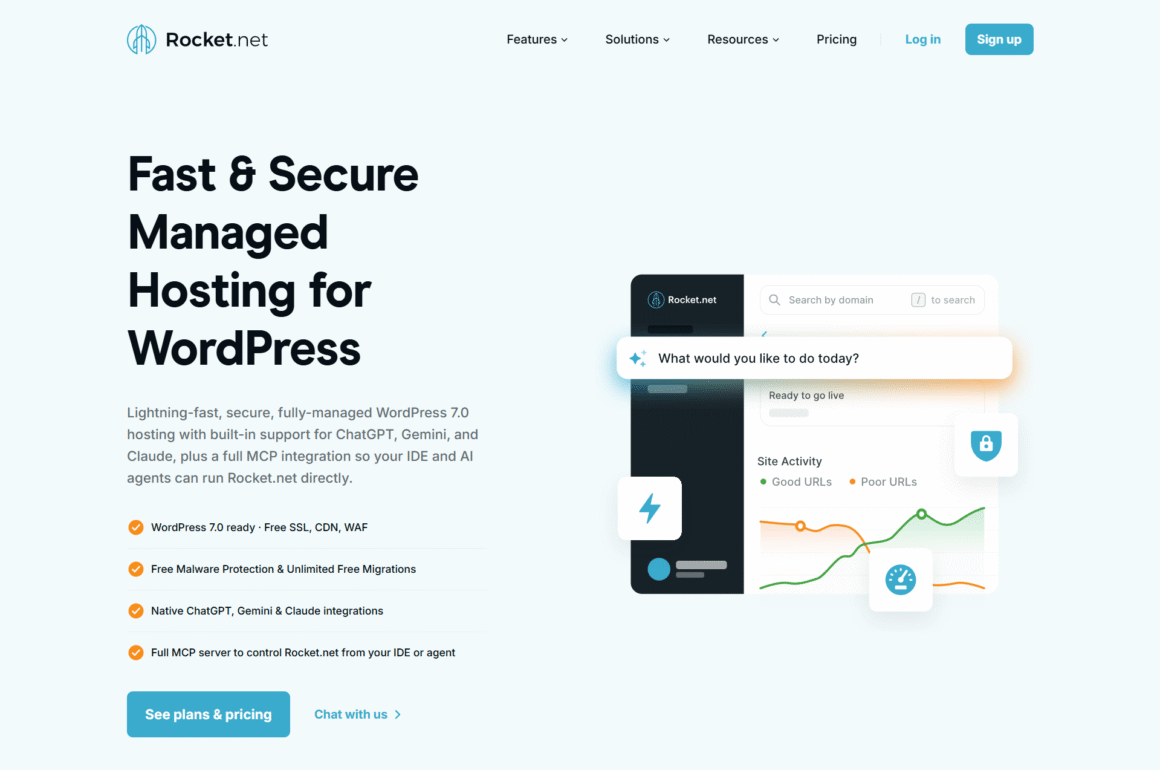
Rocket.net is a managed WordPress hosting provider that launched with a specific mission: to build the fastest WordPress stack available by integrating Cloudflare Enterprise directly into every hosting plan—not as an upsell, not as a third-party add-on, but baked into the infrastructure from day one.
Most managed hosts bolt Cloudflare on as an optional feature or offer their own CDN. Rocket.net took a different approach. Every site on the platform runs through Cloudflare’s enterprise-tier network, which means global edge caching, advanced DDoS mitigation, and faster TTFB across every geography are included by default.
Their target audience is clear: WordPress professionals, business owners, WooCommerce operators, and agencies who need fast WordPress hosting without the overhead of managing their own server infrastructure.
You can check out Rocket.net’s current plans here → Check Plans
Rocket.net Features
Cloudflare Enterprise Included
This is the feature that separates Rocket.net from most competitors. Cloudflare Enterprise normally runs hundreds of dollars per month as a standalone product. Rocket.net bundles it with every plan.
What that means practically:
- CDN: Your site’s static assets are served from Cloudflare’s global edge network, not a single data center
- Edge caching: Full-page caching at Cloudflare’s edge nodes means faster load times even for first-time visitors
- Security: Enterprise-level WAF rules, bot protection, and threat intelligence
- Performance benefits: Reduced origin server load, smarter routing, and significantly lower TTFB in regions far from your server
For context—most shared or mid-tier managed hosts give you a basic CDN; Rocket.net gives you the same network layer that Fortune 500 companies use.
Built-In Caching
Rocket.net runs a full-stack caching system that works at multiple layers: server-level caching, object caching, and Cloudflare edge caching working together. You don’t need a separate caching plugin mucking up your plugin list. In practice, this means faster page loads without the configuration headaches that come with manually tuning WP Rocket or W3 Total Cache.
Automated Backups
Daily automated backups are included. You can also trigger manual backups before making major changes. Restoration is straightforward through the dashboard — no support ticket needed for simple restores.
Free Migrations

Rocket.net handles site migrations for free. Their migration team will move your existing WordPress site over, which matters when you’re dealing with a complex WooCommerce store or a multi-plugin setup that can break during manual migration.
Staging Environments
One-click staging environments are included. Push changes to staging, test, then deploy to production. If something breaks in staging, your live site stays untouched. This is standard across most premium WordPress hosting providers now, but Rocket.net’s implementation is clean and reliable.
WordPress Security
WordPress security on Rocket.net runs at multiple layers. The Cloudflare Enterprise WAF handles a massive volume of threats before they ever reach your server. On top of that, Rocket.net adds its own security hardening, malware scanning, and proactive monitoring.
- DDoS protection via Cloudflare’s enterprise mitigation
- Malware scanning with automated alerts
- SSL certificates included and auto-renewed
- Firewall rules updated continuously
For WooCommerce stores handling payments, this kind of layered WordPress security isn’t optional—it’s essential.
Automatic Updates
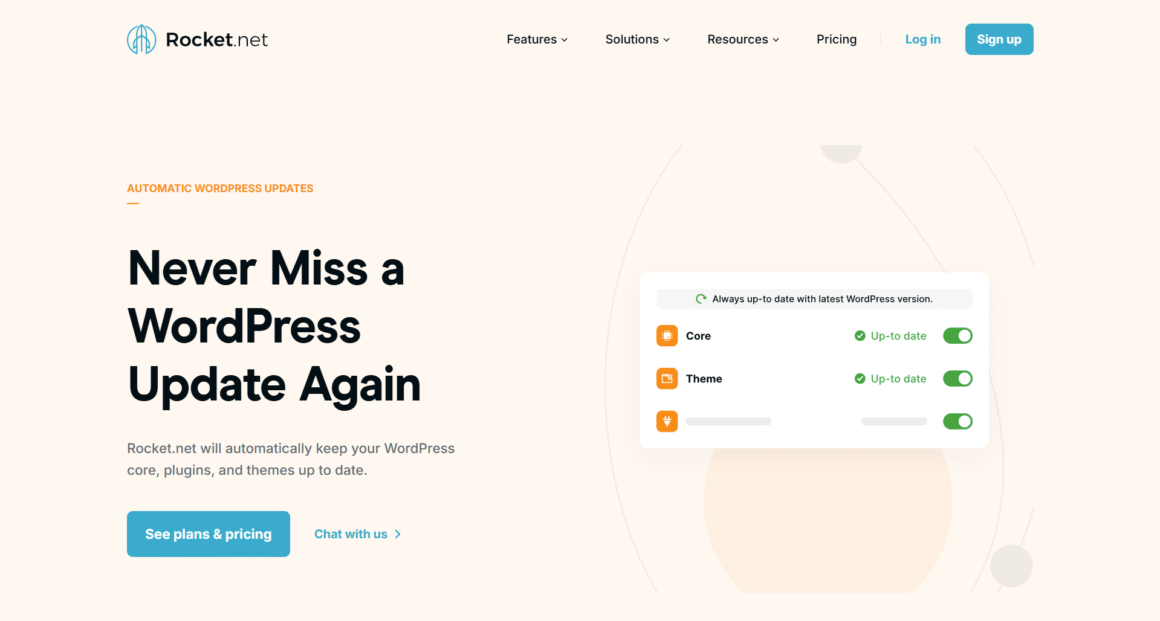
Rocket.net handles WordPress core updates automatically. You can configure plugin and theme update behavior based on your workflow. It’s not as granular as managing everything yourself, but for most users, automated updates with rollback capability is the right default.
Performance Testing and Speed Analysis
Speed is the core selling point of Rocket.net hosting, so let’s take it seriously.
Page Load Speed
Real-world load times consistently put Rocket.net at or near the top of managed host comparisons. Multiple independent testing tools—GTmetrix, WebPageTest, Pingdom—show sub-second fully loaded times for optimized WordPress sites on Rocket.net’s infrastructure.
Global Performance
This is where the Cloudflare Enterprise integration becomes tangible. Most managed hosts show strong performance near their data centers and slower times further away. Rocket.net’s edge caching flattens that curve significantly. European users hitting a US-hosted site, or Asian users doing the same, see dramatically better performance than they would on a host without true enterprise CDN integration.
Core Web Vitals Performance
Core Web Vitals—LCP, CLS, INP—are where Rocket.net really earns its reputation. The combination of edge caching, optimized stack, and reduced TTFB produces scores that translate directly to better Google search rankings. Sites migrating from shared hosting to Rocket.net routinely see LCP scores drop from “Needs Improvement” to “Good” without changing a line of code.
Time to First Byte (TTFB)
TTFB is one of the most reliable performance metrics for evaluating hosting infrastructure. Rocket.net consistently delivers low TTFB across multiple test locations. The edge caching setup means a large percentage of requests are served from Cloudflare’s edge rather than hitting the origin server, which is why TTFB numbers look so good from geographically diverse testing locations.
Traffic Handling
High-traffic WordPress hosting is where infrastructure choices show their true cost. Rocket.net’s scalable WordPress hosting architecture handles traffic spikes more gracefully than mid-tier managed hosts. You’re not sharing a fixed pool of resources with dozens of other sites—the Cloudflare edge layer absorbs the load before it reaches your origin.
If you’re comparing hosting providers for a WordPress site with growing traffic, see our guide to the best WordPress hosting for high-traffic websites.
Comparison: Rocket.net vs Kinsta vs WP Engine vs Flywheel
Without inventing benchmark numbers, the honest pattern across independent testing:
- Kinsta: Covered in our Kinsta Review 2026, runs on Google Cloud, and is consistently fast, particularly in regions where Google’s network is strong. TTFB is competitive. The gap with Rocket.net narrows when Kinsta’s own CDN is fully configured.
- WP Engine: See our WP Engine Review 2026. It is solid and reliable but has historically shown higher TTFB than both Rocket.net and Kinsta in head-to-head tests.
- Flywheel: Covered in Flywheel Review 2026 is excellent for agencies and designers but isn’t positioned as a performance-first host the way Rocket.net is.
In the Kinsta vs Rocket.net and WP Engine vs Rocket.net comparisons, Rocket.net tends to win on raw TTFB and global consistency. Kinsta wins on dashboard polish. WP Engine wins on agency workflow tools.
Ready to try it? → [Start with Rocket.net today]
Ease of Use
The Rocket.net dashboard is clean and purpose-built. It doesn’t try to be cPanel or a general hosting control panel — it’s focused entirely on WordPress management.
Spinning up a new site takes under two minutes. Backups, staging, and domain management are all accessible without hunting through nested menus. Migrations are handled for you, which removes the most common friction point for new customers.
That said, it’s not as visually polished as Kinsta’s dashboard, which remains the benchmark for managed WordPress UX. Rocket.net’s interface is functional and well-organized but lacks some of the dashboard analytics that power users on Kinsta appreciate.
For most users — including WordPress hosting beginners moving up from shared hosting — Rocket.net’s dashboard is genuinely easy to navigate.
Rocket.net for WooCommerce
WooCommerce hosting performance comes down to a few things: checkout speed, database query handling, and behavior under concurrent traffic. Rocket.net addresses all three well.
Managed WooCommerce hosting on Rocket.net benefits directly from the edge caching setup. Product pages load fast. The checkout flow — which bypasses page caching — still benefits from optimized server response times.
For product-heavy stores with hundreds or thousands of SKUs, the server-side optimization matters more than CDN layer caching. Rocket.net’s stack handles database-intensive WooCommerce setups without the slowdowns that budget shared hosts suffer under comparable product volumes.
Website speed optimization for WooCommerce isn’t just about user experience — it directly affects cart abandonment and conversion rates. A 1-second delay in checkout load time can meaningfully reduce completed purchases. Rocket.net’s infrastructure keeps those numbers in the right direction.
Who benefits most? Store owners running mid-to-high-traffic WooCommerce sites, particularly those who’ve outgrown SiteGround or Bluehost’s managed WooCommerce offerings.
Security Review
WordPress security on Rocket.net is genuinely strong. The Cloudflare Enterprise WAF is the crown jewel — it blocks known attack patterns, zero-day exploits, and bot traffic at the network edge before requests reach your WordPress installation.
Layer by layer:
- Firewall: Cloudflare Enterprise WAF + Rocket.net’s own application-level rules
- DDoS protection: Cloudflare’s enterprise mitigation handles volumetric attacks that would overwhelm most managed hosts
- Malware scanning: Continuous scanning with alerting
- SSL: Auto-provisioned, auto-renewed Let’s Encrypt or custom certificates
- Brute force protection: Login protection and rate limiting
For WooCommerce stores handling customer data and payments, this security posture is reassuring. It’s not security theater—it’s real enterprise-grade infrastructure.
Support Quality
WordPress hosting support at Rocket.net is handled by WordPress-specialized staff, not generalist tech support. That matters when your issue involves a specific plugin conflict or a WooCommerce configuration edge case.
Response times via live chat have been consistently fast in my experience — typically under a few minutes during business hours. The support team demonstrates actual WordPress knowledge rather than reading from a script.
If there’s a criticism, it’s that support is chat-and-ticket-based. There’s no phone support option, which matters to some enterprise customers. This is consistent with most managed WordPress providers but is worth knowing.
Overall, support is strong and represents a genuine advantage over budget shared hosting providers.
Pricing and Value

Premium WordPress hosting costs money, and Rocket.net sits in the premium tier alongside Kinsta and WP Engine. The entry-level plan covers a single site with meaningful resource allocations, and plans scale up for agencies and larger deployments.
Is it worth the cost? The honest answer depends on what you’re running.
If your site generates meaningful revenue—either directly through WooCommerce or indirectly through leads, ads, or content—then the website speed optimization and security benefits almost certainly justify the premium over shared or budget-managed hosting. The Core Web Vitals improvements alone can produce measurable SEO gains.
If you’re running a personal blog or a low-traffic hobby site, shared hosting or an entry-level managed host will serve you fine. See our [Shared Hosting vs Managed WordPress Hosting] guide for a fuller breakdown.
What you’re paying for at Rocket.net: Cloudflare Enterprise (which alone costs hundreds per month standalone), managed infrastructure, WordPress expertise, and the hours you don’t spend debugging server configuration. For business sites, that math typically works in your favor.
Pros and Cons
Pros
- Cloudflare Enterprise included in every plan — genuine competitive advantage
- Exceptional Core Web Vitals and TTFB performance
- Strong WordPress security with enterprise-grade WAF
- Clean, focused dashboard with easy site management
- Excellent WooCommerce hosting performance for mid-to-large stores
- Free migrations handled by their team
- Staging environments included
- WordPress-specialized support
Cons
- Premium pricing — not competitive with budget shared or entry-level managed hosts
- Dashboard less polished than Kinsta’s
- No phone support
- Fewer third-party integrations than WP Engine
- Overkill for low-traffic personal sites
See Rocket.net’s Latest Pricing & Plans
Rocket.net vs Kinsta
Both are premium managed hosts with strong performance. Key differences:
| Features | Rocket.net | Kinsta |
|---|---|---|
| Infrastructure | Cloudflare Enterprise edge | Google Cloud |
| CDN | Cloudflare Enterprise (included) | Cloudflare CDN (separate add-on tier) |
| Dashboard | Clean, functional | More polished, better analytics |
| TTFB | Faster in independent tests | Very competitive |
| Pricing | Comparable | Comparable |
| Support | WordPress-specialized chat | WordPress-specialized chat |
Winner for raw speed: Rocket.net, particularly for global performance.
Winner for dashboard and analytics: Kinsta.
Winner for most users: Depends on priorities
Rocket.net vs WP Engine
WP Engine has a longer history and deeper agency tooling. But performance comparisons consistently favor Rocket.net.
| Features | Rocket.net | WP Engine |
|---|---|---|
| Speed/TTFB | Faster | Slower in most tests |
| Agency workflow tools | Basic | Strong (Flywheel acquisition) |
| Security | Cloudflare Enterprise | Good, but not enterprise CDN |
| Pricing | Competitive | Higher at comparable tiers |
Winner for performance: Rocket.net.
Winner for agency workflows: WP Engine.
Winner for WooCommerce: Rocket.net.
Who Should Use Rocket.net?
Bloggers
Mid-to-high traffic bloggers whose ad revenue or SEO rankings are tied to site speed. If you’re monetizing, fast WordPress hosting pays for itself.
Business Websites
Any business site where first impressions and load times affect conversions. WordPress performance directly affects bounce rates and lead generation.
WooCommerce Stores
Strong fit. Managed WooCommerce hosting on Rocket.net handles the performance and security demands of e-commerce without requiring server management expertise.
Agencies
Viable for agencies managing multiple client sites. Not as agency-workflow-focused as WP Engine, but the performance difference can be a selling point to clients. Check our Best Managed WordPress Hosting Providers roundup for agency-focused options.
High-Traffic Websites
High-traffic WordPress hosting and scalable WordPress hosting are genuine strengths. The Cloudflare edge layer handles traffic spikes gracefully.
Beginners
Comfortable for beginners moving up from shared hosting, provided the budget works. The managed setup means less technical overhead.
Who Should Avoid Rocket.net
- Hobbyist bloggers or anyone with a tight budget—shared hosting or entry-level managed hosts (see [Fastest WordPress Hosting in 2026] for alternatives) will serve low-traffic personal sites well
- Users who need deep agency workflow tools (WP Engine may be better)
- Sites that don’t need enterprise CDN performance — you’d be paying for infrastructure you don’t use
People Also Ask
Is Rocket.net better than Kinsta?
For raw speed and global TTFB, Rocket.net has an edge due to its Cloudflare Enterprise integration. Kinsta offers a more polished dashboard and better analytics. For most business and WooCommerce sites, Rocket.net performs slightly better. For dashboard-heavy workflows, Kinsta may suit you better.
Is Rocket.net faster than WP Engine?
Yes, consistently in independent testing. Rocket.net’s Cloudflare Enterprise edge caching produces lower TTFB and better Core Web Vitals scores than WP Engine’s infrastructure in most comparisons.
Does Rocket.net include Cloudflare Enterprise?
Yes. Cloudflare Enterprise is included in every Rocket.net plan — not as an add-on. This is one of its primary differentiators from other managed hosts.
Is Rocket.net good for WooCommerce?
Yes. Rocket.net handles WooCommerce well, particularly for mid-to-large stores. Performance under concurrent traffic and checkout speed are both strong. It’s among the best options for managed WooCommerce hosting.
Is Rocket.net worth the money?
For business sites, WooCommerce stores, and high-traffic WordPress sites — yes. The Cloudflare Enterprise infrastructure and managed security represent real value. For personal or low-traffic sites, the price may not be justified.
What makes Rocket.net different from other managed hosts?
The Cloudflare Enterprise inclusion is the headline differentiator. Most hosts either don’t include a CDN, offer a basic CDN, or charge extra for Cloudflare integration. Rocket.net gives every customer enterprise-tier CDN and security infrastructure by default — which directly produces the speed and Core Web Vitals results it’s known for.
Final Verdict: Is Rocket.net the Fastest Managed WordPress Hosting in 2026?
Among the major managed WordPress providers, Rocket.net makes the strongest case for the speed title—particularly when you factor in global performance and Core Web Vitals consistency.
The Cloudflare Enterprise integration isn’t marketing. It produces measurable differences in TTFB, LCP, and load times across geographies. When independent testers run the same WordPress theme against Rocket.net, Kinsta, and WP Engine, Rocket.net’s edge caching advantage shows up repeatedly.
Is it the right host for everyone? No. Budget-conscious personal bloggers don’t need this level of infrastructure. But for WooCommerce hosting, business sites where speed affects revenue, and agencies promising performance to clients—Rocket.net earns its reputation as one of the best managed WordPress hosting providers in 2026.
👉 Try Rocket.net — Check Current Plans & Pricing