

Disclosure: Some links on Themezhub are affiliate links. We may earn a commission if you make a purchase through them.
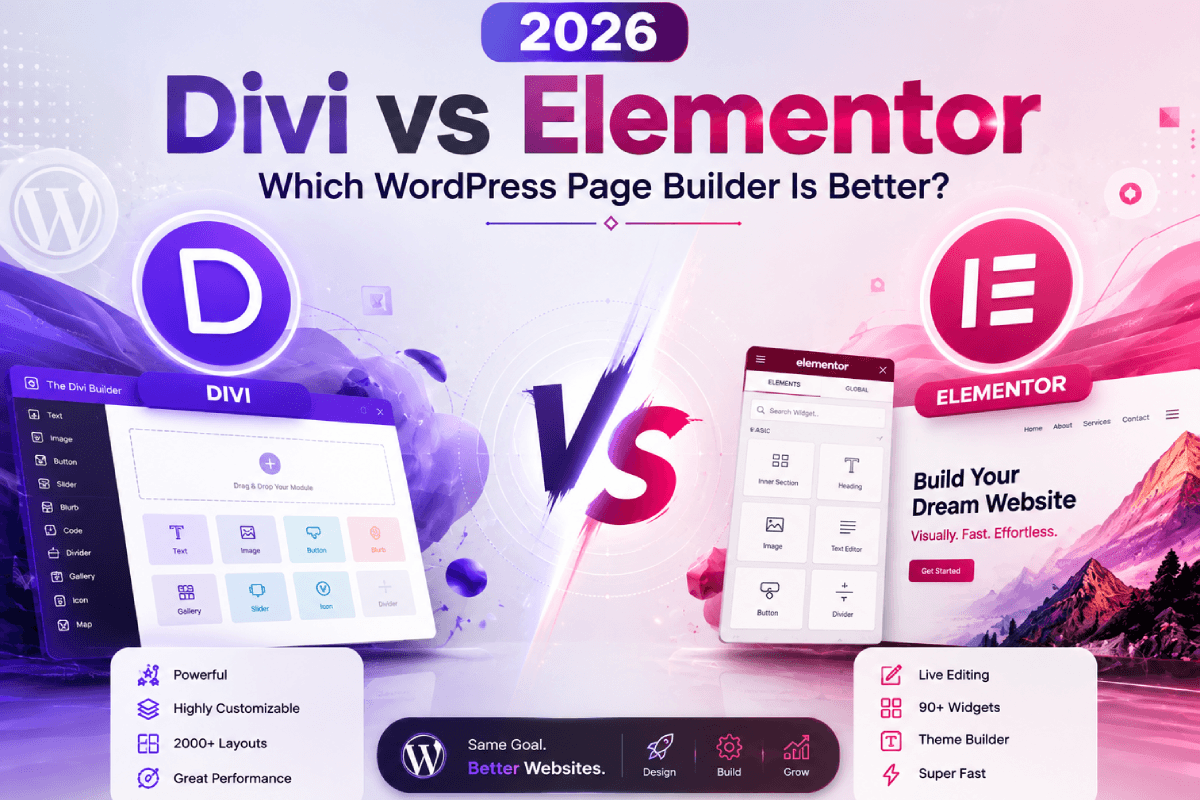
Divi and Elementor are two popular tools used by millions for building WordPress sites. Both tools allow you to build pages yourself using a visual editor instead of writing code. And both have changed quite a bit recently. Divi 5 is out of beta now, with a new architecture and a different editing approach. Elementor has been updating its editor too, adding more AI tools along the way. You should know about these changes, especially when you are choosing a builder in 2026.
So which one is the best WordPress page builder for you? That comes down to what you actually need from a page builder. Maybe it is design controls or templates. Maybe it is performance or pricing. Or maybe you just want the full set of tools to build a whole site.
In this comparison, we look at Divi and Elementor side by side. We cover their features and performance. We also cover SEO, pricing, and ease of use. Beyond that, we look at what changed in 2026 and which builder fits which type of WordPress user best.
Quick Answer: Divi or Elementor?
Choose Divi if
Choose Elementor if
- You build multiple websites—Divi’s eligible plans allow unlimited website usage.
- You’re a freelancer or agency—unlimited website usage can make Divi more cost-effective for multiple client sites.
- You prefer Divi’s visual builder—Divi 5 offers a powerful visual workflow with variables, presets, flexbox, and CSS grid.
- You want to start for free — Elementor’s free version lets you try the builder before paying.
- You’re a beginner—its editing workflow is easy to get started with.
- You want a wider ecosystem—Elementor offers a large ecosystem of extensions and integrations.
What’s New With Divi and Elementor in 2026?
Both WordPress page builders have made major changes over time. Therefore, it becomes important that we compare the latest versions of both builders to get a clear picture.
Divi 5 officially left beta in February 2026. It is built on a new foundation with changes to its code, layout system, and visual builder. Divi 5 also adds features such as Flexbox, CSS Grid, design variables, and presets. Divi AI is built into Divi, and Divi members can use it on a limited trial. Unlimited AI usage requires a separate Divi AI subscription or Divi Pro.
Elementor 4.0 is now live. It introduces a new atomic foundation built around reusable classes, variables, and components. New Elementor installations have these Atomic features enabled by default, while existing websites can continue using their current setup and enable the new features manually. Elementor has also expanded its AI tools, with AI features available for generating layouts, content, images, and code depending on the plan.
For someone choosing a builder today, these changes are important. Divi 5 is now a released version, while Elementor 4.0 is live with its new Atomic system and additional capabilities continuing to roll out. Both builders are also putting more focus on performance and AI now. An older comparison may not match what you get today.
Divi 5 vs Elementor 4: What’s Actually Different?
Divi 5 and Elementor 4 both bring major changes. But each one takes a different approach to how websites get built and managed. Divi 5 is a rebuilt version of Divi, with a new architecture and layout system. Elementor 4 introduces its Atomic approach instead, focused on reusable design systems and more consistent styling.
New Architecture and Editor Approach
Divi 5 came out officially on February 26, 2026, after leaving beta. Its new architecture changes how layouts and modules work inside the Visual Builder. The new system also introduces modern layout tools such as Flexbox and CSS Grid.
Elementor 4.0 is also live. Its atomic approach is built around reusable classes, variables, and components. New Elementor installations have the Atomic features enabled by default, while existing websites can continue using their current setup and adopt the new features manually.
Editing Workflow
The two builders still feel different when you work with them. Divi 5 keeps its Visual Builder approach while giving users more control over layouts and structure. Modules can use Flexbox and CSS Grid, which changes how elements can be arranged inside a layout.
Elementor 4 takes a more system-based approach. Its atomic elements use a common styling system, so classes and variables can be reused instead of styling each element separately. Components, available in Elementor Pro, can also be reused across a website, with changes to a component reflected across its instances.
Design Systems and Reusable Settings
This is where the two builders differ the most.
Divi 5 uses design variables and presets. Variables can store values like colors, fonts, and sizing. Presets work a bit differently. They save design settings so you can apply them across different elements later. Elementor 4 takes its own approach here, using classes, variables, and components instead. Classes let you reuse styles across a site. Variables define values such as colors and font sizes. Components go a step further, letting you reuse whole sections while keeping them synchronized everywhere they appear.
Flexbox and CSS Grid
Divi 5 includes Flexbox and CSS Grid as part of its updated layout system. Flexbox handles arranging elements in rows or columns. CSS Grid gives you more control over two-dimensional layouts. Elementor 4 supports CSS Grid too, inside its Atomic Editor. Grid works with Classes and variables, so you can use it as part of the same design system rather than managing it separately.
Backward Compatibility
Both builders made the switch easier for existing users, just in different ways. Divi 5 keeps backward compatibility for unsupported Divi 4 modules. That means legacy content keeps working while users and third-party developers update their modules over time.
Elementor 4 does not force existing websites into the new workflow. Existing sites can continue using their current setup and manually enable Atomic features when they are ready. V4 elements can also be used alongside existing Elementor widgets on the same page.
For anyone choosing a builder in 2026, the real difference comes down to direction. Divi 5 leans into its rebuilt layout system and design variables. Elementor 4 leans into reusable classes, variables, and components.
Divi vs Elementor: Quick Comparison
Divi and Elementor share a lot of the same basic tools, but a few real differences separate them. Divi focuses on its integrated ecosystem and unlimited website licensing, while Elementor offers a free version and a large ecosystem of extensions and integrations. The table below gives you a quick look at the main differences before we compare the two builders in more detail.
| Feature | Divi | Elementor |
| Free version | No | Yes |
| Visual editor | Yes | Yes |
| Theme builder | Yes | Yes |
| Templates | Yes | Yes |
| WooCommerce tools | Yes | Yes |
| Responsive controls | Yes | Yes |
| Design system tools | Variables and Presets | Classes, Variables and Components |
| Website licensing | Unlimited websites on eligible plans | Depends on plan |
Divi vs Elementor Features Compared
Divi and Elementor share a lot of the same tools. But using them feels different. The editor is different. So are the design controls, the templates, the theme building, and the WooCommerce tools. These differences can matter when you are choosing between the two.
Visual Editor and Page-Building Experience
With the Divi builder, you edit a page and watch the changes happen live. Add a module, drag it where you want, and adjust its settings, all without leaving the page. Divi 5 brings a redesigned visual builder into that mix too, along with a new layout system underneath it.
The Elementor page builder also uses visual editing. You can add widgets to a page and change their settings from the editor. Elementor 4 adds classes, variables, and components to the workflow.
So where do the two really differ? Mostly in how they organize the work. Divi builds around its module system. Elementor builds around widgets and an editing panel. Neither one makes you write code to tweak a small design change.
Design Flexibility and Customization
Both builders let you control the usual things. Fonts and colors are part of that. So is spacing. You can also adjust borders and shadows, plus animations, all without touching custom CSS.
Divi 5 adds two useful tools here, Design Variables and Presets. They help keep your fonts, colors, and spacing consistent across a whole site. Flexbox and CSS Grid are supported too, for building out layouts.
Elementor has leaned into reusable design settings as well. Classes, variables, and components all help manage styles across different parts of a site.
A small site gives you plenty of control either way. But things change once you add several pages to the website while trying to keep the design the same in all of them.
Templates and Pre-Built Designs
Neither builder starts you off with a blank page. Divi hands you pre-built layouts you can import and tweak. That saves real time on a business site. It helps on a blog too, or a landing page.
Elementor takes a similar approach with templates and website kits. Start with one, then swap in your own text, images, and colors.
Both go beyond single pages too, working more like full website builders. Look at a landing page as one example. A ready-made layout can save time compared with starting from a blank page.
Theme Builder and Dynamic Content
Both tools reach past individual pages. Their theme-building features let you build templates for parts of the site that repeat, headers, footers, and the like.
Divi’s Theme Builder covers headers and footers. It also handles blog posts, archives, and other repeating areas. You get to choose where each template shows up too.
Elementor’s Theme Builder does much the same, covering headers, footers, posts, and archives. Its dynamic content tools also let you pull information from WordPress into your designs.
This matters most once you want control over the whole site at once. Instead of editing the same design forty different times, you update one template, and it updates everywhere.
WooCommerce and Ecommerce
Both builders plug into WooCommerce. Each one gives you tools for shaping how an online store looks and feels.
Divi comes with WooCommerce modules for product pages and shop layouts. Cart and checkout pages are covered too. Elementor offers its own widgets and templates for products, shops, carts, and checkout. What you actually get depends on your plan either way.
Running a WooCommerce store does not make one builder the obvious winner. It comes down to which design controls you like, what your plan includes, and how hands-on you want to be running the store.
Divi vs Elementor Performance: Which Is Faster?
Speed matters when you pick a page builder. But there is no single answer to which one is faster. A lot goes into it. Your hosting plays a part. So do your images, your plugins, your caching, and how the page itself gets built.
Divi Performance
Divi 5 is a full rebuild with a new architecture, and Elegant Themes has continued adding performance improvements through 2026. Modern layout options are part of that, things like Flexbox and CSS Grid. The goal behind all this is simple: make the builder run more efficiently and give you more control over how pages come together.
Divi 5 also uses speculative prerendering to speed up navigation within the Visual Builder. It predicts where you are likely to go and preloads the destination before you click. This applies to the builder experience, not the front-end browsing experience of site visitors.
Elementor Performance
Elementor also offers performance features such as element caching and optimized control loading. Element caching stores the output of supported elements so they do not need to be rendered again each time. Elementor says this can reduce server memory use and improve time to first byte. These performance features are currently listed as experimental.
Its container-based approach can help you build simpler page structures, although the final performance still depends on how the site is built.
What Actually Affects WordPress Page Speed?
The page builder is only one part of the equation. Your hosting can affect server response time. Large images can slow down a page. Too many plugins can add extra scripts and requests.
Caching and a CDN can also help. How you build the page matters too. A page with just a few sections is easy to optimize. Animations slow things down. So do videos and third-party scripts.
Which Is the Fastest WordPress Page Builder?
There is no fair way to call Divi or Elementor the faster one. Not without testing the same site under the same conditions. Both companies have introduced performance-related improvements in their latest versions. Results still shift from one website to the next. If speed really matters to you, test the actual site you plan to build. Look at its page size and loading time. Check its Core Web Vitals and server response too, rather than trusting a general speed claim from either company.
Divi vs Elementor for SEO
Picking Divi or Elementor will not boost your rankings by itself. Your content still matters. So does your site structure, your links, and your technical SEO. What both builders do give you is the tools to build and manage an SEO-friendly site.
Page Structure and Content
Both builders let you control the basics: headings, text, images, links. Mobile visitors get responsive layouts too.
How you use those controls is what really matters. Clear headings and real content beat a page full of design elements with nothing to say.
Performance and Core Web Vitals
Performance ties into SEO too. A slow site hurts the experience, but the builder is just one piece of that puzzle.
Your hosting affects load times. So do your images, plugins, caching, and fonts, along with how the page is structured. That is why the same builder can run fast on one site and slow on another.
SEO Plugins and Other Tools
Both builders work fine with popular SEO plugins. Divi pairs well with Yoast SEO and Rank Math. Elementor works alongside common SEO tools too.
These plugins handle titles and meta descriptions. Sitemaps, schema, and general on-page SEO fall under that too. But installing one does not mean your site is automatically optimized. The content still needs real work, and so does everything else on the site.
Which Is Better for SEO?
Neither Divi nor Elementor wins outright on SEO. Both can build a site that ranks well. If you are choosing between them, treat SEO as one factor among several. Look at performance, design controls, and templates too, along with pricing and the kind of site you actually want to build.
Divi vs Elementor Pricing
Divi and Elementor follow different pricing models. Divi offers unlimited website usage with its main plans, while Elementor has a free version and paid plans with different website limits and features. Prices can change, so the figures below reflect the current pricing shown by the providers.
| Plan | Price | Websites | Key Details |
| Divi | $89/year | Unlimited | Divi theme and builder, Divi Dash, updates and support |
| Divi Lifetime | $249 one-time | Unlimited | Lifetime access to Divi, Divi Dash, updates and support |
Divi also offers separate Pro services, but they are not included in the standard Divi membership.
| Plan | Price | Websites | Key Details |
| Free | $0 | Unlimited | Basic Elementor editor and core website-building tools |
| Essential | $60/year | 1 | Theme Builder, Dynamic Content and Form Builder |
| Advanced Solo | $84/year | 1 | Advanced features, Popup Builder, custom code, CSS, and e-commerce |
| Advanced | $99/year | 3 | Advanced features for up to 3 websites |
| Elementor One | $168/year | 1 | 25,000 monthly One credits, Editor Pro features, AI-generated code, copy, images and layouts; image optimization; accessibility; and site management |
| Expert | $204/year | 25 | Editor Pro features for up to 25 websites, including Theme Builder, Dynamic Content, Form Builder, Popup Builder, custom code and CSS, and e-commerce features |
Elementor also offers One plans that combine the website builder with additional services and AI features. These plans are separate from the standard Editor Pro plans.
Divi vs Elementor for Different Types of WordPress Users
The right choice can shift depending on what kind of website you are building. A beginner probably wants something easy to get started with. A freelancer might care more about website limits and reusable designs. Here is how Divi and Elementor compare for different users.
Best for Beginners
Want to test a page builder before spending money? Elementor is worth starting with. The basic editor comes free. That lets you get a feel for how it works before spending anything. Divi also lets you build websites visually, but its standard builder requires a paid membership.
That makes Elementor a little easier to try without making a purchase first. If you already know you want Divi, however, the lack of a free version may not matter much.
Best for Bloggers and Content Websites
Both builders handle blogs and content-focused sites well. Divi’s Theme Builder lets you create layouts for posts and archives. Elementor offers similar options through its own Theme Builder.
For a blog, it usually comes down to which editor you prefer and how you like managing templates. You do not need the most advanced features from either builder to publish a regular blog.
Best for Freelancers and Agencies
Divi is a better option for freelancers and agencies because they can get unlimited website usage in its standard plans. You can use the same membership to build websites for multiple clients without buying a separate Divi license for each site.
Elementor also has plans for users who manage multiple websites. Its paid plans increase the number of sites you can use, so you can choose a plan based on how many client websites you manage.
Best for Ecommerce
Both builders work with WooCommerce, so product pages and other store elements are covered either way. Already have a favorite editor? There is not much reason to switch just for an e-commerce site.
For an online store, compare what WooCommerce features each plan actually includes. Also think about the other plugins you plan to use alongside it.
Best for Developers and Advanced Users
Developers and advanced users usually want more control. They want to write custom code. They also want more say over layouts and styles. Elementor provides custom CSS and code features on its higher plans. Third-party plugins and integrations add to that list too on Elementor’s side. Over on Divi’s side, Divi 5 hands advanced users tools like Flexbox, CSS Grid, variables, and presets, which can be useful when you want more control over the design system of a website.
That said, neither tool is only for developers. Anybody can use either of the builders to build full WordPress websites because there is no coding required.
Divi vs Elementor: Pros and Cons
Each builder has real strengths. Each has real limits too. What works great for one site might not work at all for another.
Divi Pros and Cons
Pros
- A new architecture in Divi 5, with tools like Flexbox, CSS Grid, variables, and presets.
- Unlimited website usage on the main plans, handy for freelancers and agencies.
- A visual builder that gives you real control over layouts and design.
- A lifetime plan, too, is useful if you plan to stick with Divi long term.
Cons
- No free version exists, so you need a paid plan from day one.
- The visual editing workflow takes some getting used to for newcomers.
- Older Divi sites moving to Divi 5 may hit a few extra steps along the way. Sites using third-party modules should expect a few compatibility checks. Divi 5 does include a backward compatibility system for unsupported Divi 4 modules, but testing before migration is still the safer move.
Elementor Pros and Cons
Pros
- A free version lets you try the basic editor before paying anything.
- Editor 4 brings classes, variables, and components for managing reusable design settings.
- It offers a large selection of widgets and tools for websites, marketing, and e-commerce.
- A large ecosystem of third-party plugins and integrations rounds things out too.
Cons
- Website limits shift by plan, so agencies need to pick based on how many sites they are managing.
- Additional atomic features are continuing to roll out after the Editor 4 launch.
- More third-party extensions mean more options. You have to be picky about what you actually install too.
Divi vs Elementor: Which One Should You Choose?
What you need from a builder decides the better choice here. Some users will find Divi makes more sense. Others will lean toward Elementor.
Choose Divi if:
Divi is a strong option if you build several websites and want unlimited website usage. It can also suit you if you prefer its visual builder and the design system introduced with Divi 5.
Choose Elementor if:
Elementor may be the better fit if you want to start with a free version. It also makes sense if you prefer its editing workflow or want to work with its classes, variables, components, and wider ecosystem.
Consider Gutenberg Instead If
You may not need either builder if your website only needs simple layouts. WordPress’s block editor can handle regular pages and posts without adding another page builder.
A dedicated builder becomes more useful when you need more control over layouts, templates, design settings, or the overall structure of the website.
Final Verdict
Both Divi and Elementor are capable WordPress page builders. They just suit different needs. Divi stands out for its unlimited website usage, plus the new design system Divi 5 brought in. Elementor is a strong choice if you want a free starting point and prefer its current editing workflow.
Neither builder wins for every site out there. Start with your budget. From there, figure out the type of site you want to build. Design control matters too, so factor that in. For most users, the right pick is whatever fits those three things best.
Frequently Asked Questions
Divi or Elementor: Which One Wins in 2026?
Your specific needs will decide that. Divi works well if you want unlimited website usage. It also works well if you like its visual builder. Elementor might suit you better if you want to try its free version first.
Is Elementor better than Divi?
Not for every website. Elementor is worth a look if you like its editing workflow. It is also worth a look if you want to start for free. Prefer Divi’s design tools or how it licenses its plans? Divi could be the smarter pick for you.
Which WordPress Page Builder Loads Faster?
No single builder wins on speed. Performance depends on more than just the builder. Your website, hosting, images, and plugins all play a role, along with caching and page structure. Both Divi and Elementor have made performance improvements recently, though we did not run a controlled speed test for this comparison.
Does Divi or Elementor Help More With SEO?
You can build a site that ranks well with either page builder. Content matters more than the builder for good SEO. The way you structure your website and create links helps improve SEO.
Is there a free WordPress page builder?
Yes. Elementor has a free version with basic tools. WordPress has its own block editor too. A simple site does not need a separate page builder at all.
What is Divi Theme Builder?
Divi Theme Builder lets you build templates for different parts of a site. Use it for headers and footers. Use it for blog posts and archives too.
Can I switch from Elementor to Divi?
Yes, but expect some extra work. Divi and Elementor each build pages their own way. You will likely need to rebuild parts of your layout. Your old designs will not just transfer over automatically.